|
The
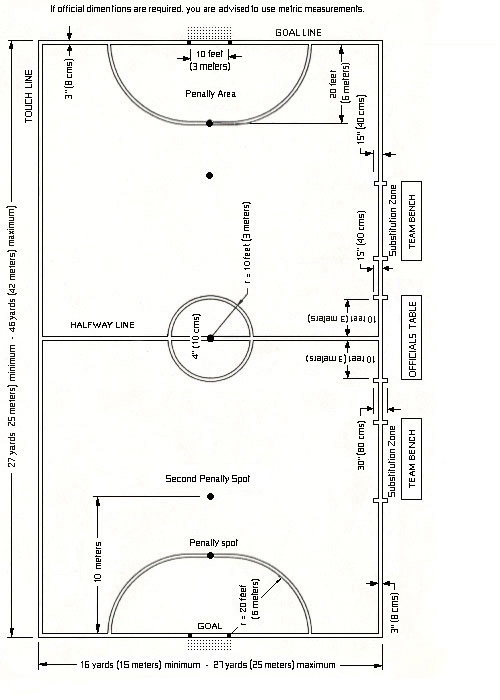
Playing court and appurtenances are shown in the following
illustration: Dimensions
The playing court must be rectangular. The length of the touchline must be greater than the length of the goal line.
International
Games
Playing
Court Markings
The
playing court is marked with lines. These lines belong to the areas
of which they are boundaries. The
two longer boundary lines are called touchlines. The two shorter lines
are called goal
lines. All
lines are 8 cm.
wide. The
Playing Court
is divided into two halves by the halfway line. The
center spot is indicated at the midpoint of the halfway line. A
circle with a radius of 3 m is marked around it. The
Penalty Area A
penalty area is defined at each end of the playing court as follows: Quarter
circles, with 6 m radius, are drawn centered on the outside of each
goal post. The quarter circles are drawn from
the
goal line to meet imaginary lines drawn at right angles to the goal
line from the outside of the goal post. The upper part of each
quarter circle is joined by a 3.16 m line running parallel to the
goal line between the goal post. Penalty
Spot A
penalty spot is drawn 6 m from the midpoint between the goal posts
and equidistant from them. Second
Penalty Spot A
second penalty spot is drawn on the playing court 10 m from the
midpoint between the goal posts and equidistant from them. The
Corner Arc A
quarter circle with a radius of 25cm from each corner is drawn
inside the playing court. Substitution
Zone The
substitution zone is situated on the same side of the playing court
as the teams’ benches and directly in front of them and is where
the players enter and leave the playing court for substitutions.
Goals Goals
must be placed
on the center of each goal line. They
consist of two upright posts equidistant from each corner and joined
at the top by a horizontal crossbar. The
distance (inside measurement) between the posts is 3 m and the
distance from the lower edge of the crossbar to the ground is 2 m. Both
goal posts and the crossbar have the same width and depth of 8 cm.
Nets, made of hemp, jute or nylon, are attached to the posts and
crossbars behind the goals. The lower part is supported by curved
bars or some other adequate support. The
depth of the goal, described as the distance from the inside edge of
the goal posts towards the outside of the playing court, is at least
80 cm (in) at the top and 100 cm (in) at ground level. Safety The
goals may be portable but they must
be anchored securely to the ground during play. The
Playing Court Surface.
The
surface is smooth and flat and non-ab ·
Decision
1 In
the event that the goal lines measure between 15 to 16 m, the radius
of the centre circle
measures only 4 m.
In this case the penalty mark is no longer situated on the
line defining the penalty area but remains at a distance of 6 m from
the midpoint between the goal posts and equidistant from them. ·
Decision
2 The
use of natural turf, artificial turf or soil is permitted for league
games but not for international games. ·
Decision
3 A
mark may be drawn outside the playing court, 5m from the corner arc
and at right angles to the goal line to ensure that this distance is
observed when a corner kick is being taken. The width of this mark
is 8 cm. ·
Decision
4 The
teams' benches are situated behind the touch lines directly next to
the space beside the timekeepers table, but no closer that 3 meters.
|
||||||||||||||||||||||||||||