.
LAW
XII – FOULS AND MISCONDUCT
Fouls
and misconduct are penalized as follows:
Direct
Free Kick
A
direct free kick is awarded to the opposing team if a player commits
any of the following six offenses in a manner considered by the referee
to be careless, reckless or using excessive force:
| · |
kicks
or attempts to kick an opponent |
|
|
| · |
trips
or attempts to trip an |
|
|
| · |
jumps
at an opponent |
|
|
| · |
charges
an opponent,
even with the shoulder |
|
|
| · |
strikes
or attempts to strike an opponent |
|
|
| ·
|
pushes
an opponent |
A
direct free kick is also awarded to the opposing team if a player
commits any of the following offenses
| · |
holds
an opponent |
|
|
| · |
spits
at an opponent |
|
|
| · |
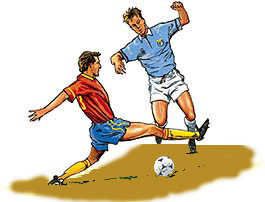
slides
in an attempt to play the ball when it is being played or |
|
attempted
to
be
played by an opponent (except for the goalkeeper in his own penalty
area) (sliding tackle) |
|
|
| · |
handles
the ball deliberately
(except for the goalkeeper in his own penalty area) |
|
|
A
direct free kick is taken from the place where the infringement occurred.
The
above fouls are accumulated fouls.
Penalty
Kick
A
Penalty Kick is awarded if a player commits any of the aforementioned
offenses
inside his own penalty area, irrespective of the position of the ball
but
provided that it is in play.
Indirect
Free Kick
An
indirect free kick is awarded to the opposing team if a goalkeeper
commits one of the following offenses:
| ·
|
after releasing the
ball from his possession, he receives it back from a |
|
team-mate, without it having
been played or touched by an opponent; |
|
|
| ·
|
touches
or controls the ball with his hands after it has been |
|
deliberately kicked
to him by a team-mate; |
|
|
| · |
touches
or controls the ball
with his hands after he has received it |
|
directly
from
a kick-in taken by a team-mate |
|
|
| ·
|
touches
or controls the ball with his hands or feet, on any part of the |
|
playing
court, for more than four seconds, except when he touches or controls
the ball on the opponent’s half of the playing court |
| An
indirect free kick is also awarded to the opposing team to be
taken from the place where the infringement occurred, if in the
opinion of the referee, a player:
|
|
| · |
plays
in a dangerous manner |
|
|
| · |
deliberately
impedes the progress of an opponent when the ball is not |
|
being
played
|
|
|
| · |
prevents the goalkeeper
from releasing the ball from his hands |
|
|
| ·
|
commits
any other offence, not previously mentioned in Law XII,
for |
|
which
play is stopped to caution or dismiss a player |
|
|
|
|
|
The
indirect free kick is taken from the place where the infringement
occurred, unless this was in the penalty area, in which case the
indirect free kick is taken from the penalty area line at the
place closest to where the infringement occurred.
|
Disciplinary
Sanctions
Cautionable
Offenses
A player
is cautioned and shown a yellow card if the commits any of the following
offenses:
| 1. |
is guilty of unsporting
conduct |
|
|
| 2. |
shows
dissent by word or action |
|
|
| 3. |
persistently
infringes the Laws of the Game |
|
|
| 4. |
delays
the restart of play |
|
|
| 5. |
fails to respect the
required distance when play is restarted with a |
|
corner kick or free
kick |
|
|
| 6. |
enters
or re-enters the playing court without the referee’s permission |
|
|
| 7. |
deliberately
leaves the playing court without the referee’s permission |
|
|
For
any of these offences, an indirect free kick is awarded to the opposing
team, to be taken from the place where the infringement occurred. If
the offence was committed within the penalty area the indirect free
kick is taken from the penalty area line at the place nearest to where
the infringement occurred. A caution is also given provided that no
graver infringement of the Laws has been committed.
Sending-off
Offenses
A
player is sent off and shown the red card if he commits any of the following
offenses
| 1. |
is
guilty of serious foul play |
|
|
| 2. |
is
guilty of violent conduct |
|
|
| 3. |
spits
an opponent or any other person |
|
|
| 4. |
denies
the opposing team a goal or an obvious goal-scoring |
|
opportunity
by |
|
|
| 5. |
deliberately
handling the ball (this does not apply to a goalkeeper |
|
within
his own penalty area) |
|
|
| 6. |
denies
an obvious goal-scoring opportunity to an opponent moving |
|
towards
the player’s goal by an offence punishable by a free kick or a
penalty kick |
|
|
| 7. |
uses
offensive, insulting or abusive language |
|
|
| 8. |
receives
a second caution in the same game |
|
|
If
play is stopped because a player is sent off the playing court for offence
3 or 4, without having committed any additional infringement of the
Laws, the game is restarted
by an indirect free kick, awarded to the opposing team, to be taken
at the place where the infringement occurred. However, if the offence
is committed in the penalty area, the indirect free kick is
taken from the penalty area line at the place nearest to where
the infringement occurred.
Decisions
| · |
Decision
1 |
|
|
|
A
player who has been sent off may not re-enter the game in course,
nor may he sit on the substitutes’ bench. A substitute player
may enter the game to complete two minutes after a team
mate has been sent off, unless a goal is scored before the two
minutes have elapsed, and provided he has the permission of the
time-keeper. In this case the following
applies: |
|